LEI registration required documents and when additional verification is needed

LEI registration required documents

Are documents required to apply for an LEI code? In most cases, companies can register an LEI code without submitting any documents. The process is fully digital and relies on official business registers. When a company appears in a public register and a person with registered signing authority submits the application, the system verifies the data automatically. In these situations, the applicant does not need to upload any supporting files. If you want to see the full step-by-step process from application to issuance, you can read how to obtain an LEI. The system requests documents only when registry data does not clearly confirm the company details or the applicant’s authority. When does LEI registration work without documents? LEI registration works without documents when the business register clearly shows the company’s details. This also requires that a director or another authorised
Read More »
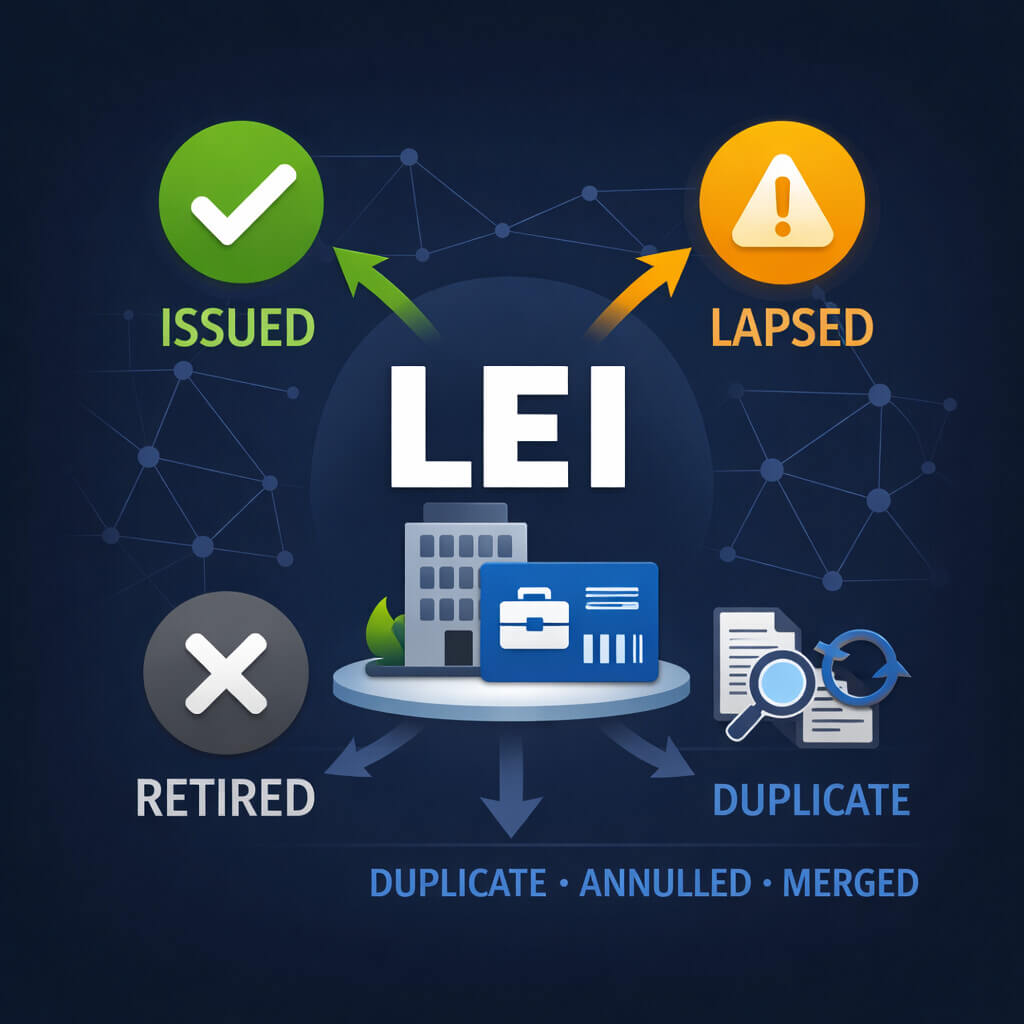
Article explaining why LEI status matters, including issued, lapsed, retired, and exception statuses in the LEI system

LEI statuses explained

Why the LEI status matters as much as the LEI itself The LEI code is used to uniquely identify legal entities in the global financial system. However, having an LEI alone does not provide the full picture. Just as important is the LEI status, which indicates whether the data linked to the LEI can be considered current and reliable. The LEI status is not designed to answer whether a specific transaction is technically possible. Its purpose is to provide a transparent signal about data quality and verification. An LEI may exist in a database, but the status determines whether it represents a well-maintained and professionally managed record. How LEI statuses form and change over time The most common LEI statuses encountered in practice are those that describe whether the entity’s reference data is up to date. These statuses apply to

Read More »
LEI Level 2 data showing company ownership and control relationships

The Business Value of LEI Level 2 Data

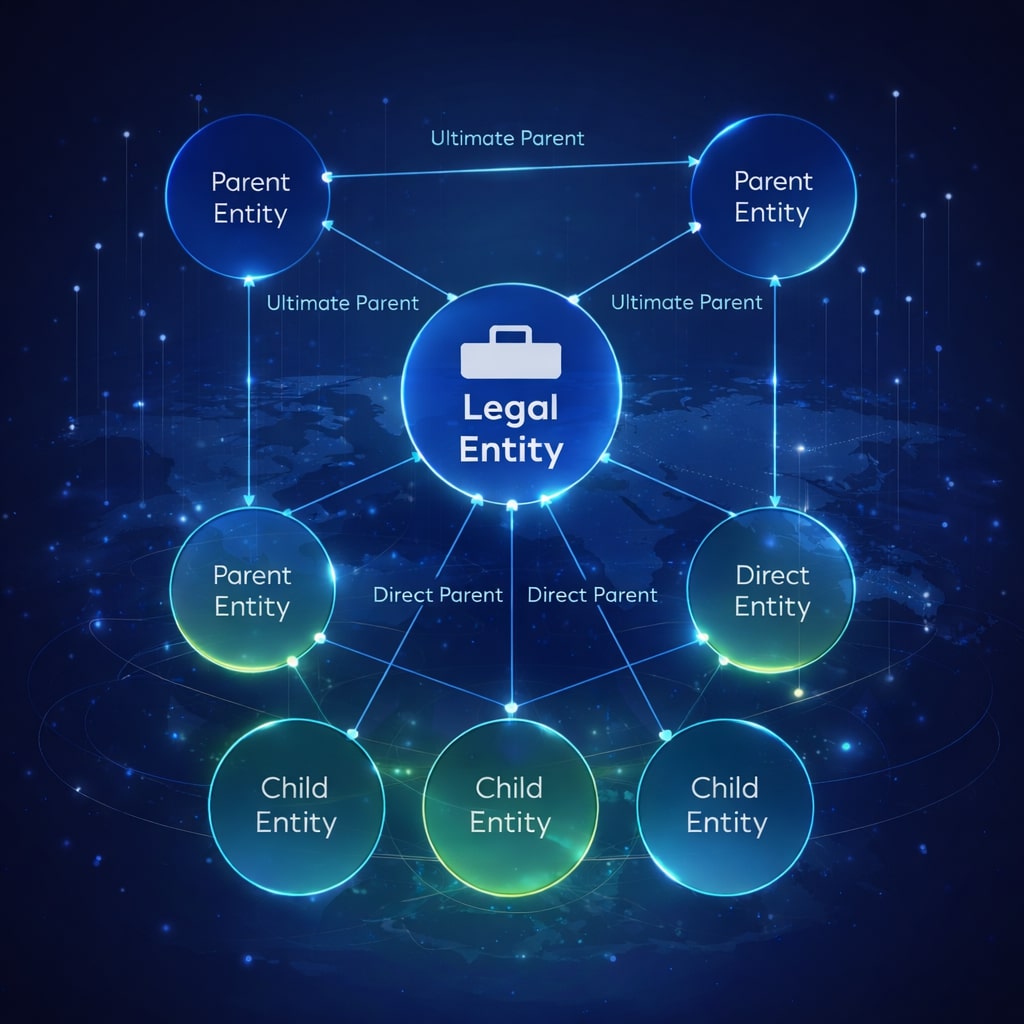
LEI beyond a formal requirement The LEI code is often seen as a formal obligation. Something that must be completed so an account can be opened, a transaction processed, or a regulatory requirement fulfilled. This view is understandable, but it only reflects part of the LEI system’s purpose. An LEI is not just an identifier. It is a structured data framework. Its real value becomes visible when looking beyond basic reference information, especially at what is known as Level 2 data. If Level 1 data answers the question of who an entity is, Level 2 data answers a more strategic question. It shows who ultimately controls that entity. At this point, the LEI moves from being a technical necessity to becoming a source of practical business insight. Seen this way, the LEI becomes not just a compliance tool, but a

Read More »
LEI and investment platforms trust and regulatory compliance

LEI and Investment Platforms

Investment platforms as regulated financial institutions Investment platforms, including brokers, trading platforms, and investment-focused fintech companies, provide access to financial markets and enable trading in instruments such as shares, bonds, funds, and derivatives. When these platforms serve corporate clients, they operate as regulated financial institutions rather than simple technology providers. In the European Union and many other jurisdictions, investment platforms are subject to financial supervision and licensing requirements. Their regulatory status obliges them to identify clients, monitor trading activity, and report certain transactions to supervisory authorities. This applies regardless of whether the platform operates traditionally as a broker or through a digital investment interface. Because investment platforms form part of the regulated financial system, their onboarding and compliance processes are designed to meet regulatory reporting and transparency requirements, not only internal business needs. Why legal entities require a different identification

Read More »
A person analyzing digital identity data on a futuristic interface, illustrating the concept of vLEI digital identity.

vLEI: A New Era of Digital Identity

vLEI – The Future of Digital Organizational Identity The digital economy continues to expand at remarkable speed. Companies sign contracts online, exchange documents across borders in seconds, and work with partners they have never met in person. Trust has become one of the most valuable currencies in this environment. For more than a decade, the Legal Entity Identifier (LEI) has provided a global, reliable way to identify legal entities in financial and business transactions. The next step in this evolution is the vLEI — the verifiable Legal Entity Identifier — designed for a world where digital processes dominate and identity needs to be verified instantly and automatically. vLEI is not a replacement for the LEI. Instead, it enhances the LEI with a cryptographically verifiable, machine-readable format that works seamlessly across digital platforms. It enables organizations to prove both their identity

Read More »
LEI supports EU Verification of Payee – digital illustration showing how the Legal Entity Identifier enhances payment verification and transparency across the EU.

How LEI Supports EU Verification of Payee and Compliance

How LEI Supports EU Verification of Payee (VOP), AML Compliance and Cyber Security Europe has entered a new era of financial transparency where data verification and identity validation are as vital as the transactions themselves. At the centre of this transformation stands the Legal Entity Identifier, or LEI, a unique 20-character code that gives each legal entity a globally verifiable identity. If this concept is new to you, read our article “What is an LEI,” which explains how the system works and why it was created after the 2008 financial crisis. You can also read “LEI Code in the European Union: Why It’s Mandatory and How It Works” to understand its importance in regulation and compliance across the EU. Why LEI Codes Are Important for the EU Verification of Payee Mandate The Verification of Payee, or VOP, initiative in the

Read More »
Global financial connections over Asia at night symbolizing LEI system and digital identity

LEI code in Asia

LEI in Asia – A New Era of Trust Asia has emerged over the past decade as a global financial powerhouse, where technological innovation and regulatory discipline have created an ideal environment for transparency. At the center of this transformation stands the Legal Entity Identifier (LEI). It is a unique 20-character code that gives every legal entity an internationally verifiable identity. For readers who are new to the concept, our article What is an LEI explains how the system works and why it was created after the 2008 financial crisis. You can also learn who needs an LEI number and how it improves transparency for businesses operating internationally. The Global Legal Entity Identifier Foundation (GLEIF) has emphasized in its recent reports that the Asia-Pacific region is critical to the future of the LEI system. In this part of the world—where

Read More »
Stacked wooden cubes spelling “RISK” with text “Expired LEI Code” — concept image showing the risk of an expired LEI.

The Risks of an Expired LEI Code

When and Why to Renew Your LEI Code: The Risks of an Expired LEI The Legal Entity Identifier (LEI) is an international identification code that proves a company’s legal existence and ensures greater transparency in the global financial system. It works like a digital passport for your business — and, like any passport, it must be renewed regularly. Yet many companies overlook this step, not realizing the potential consequences.In this article, we explain why renewing your LEI matters, what happens when it expires, and how to avoid common mistakes. LEIs are valid for 12 months — and that year passes faster than you think Each issued LEI is valid for exactly 12 months from the date of its registration or last renewal. For example, if your company’s LEI was issued on October 10, 2025, it will expire on October 09,

Read More »
Hands typing on a laptop with digital lock and EU flag graphics, symbolizing NIS2 Directive and LEI code compliance.

NIS2 and LEI

What Is NIS and Why NIS2 Matters The Network and Information Security Directive (NIS) was the EU’s first cybersecurity law, adopted in 2016. It required Member States to create competent authorities, set up national CSIRTs, and apply minimum risk management standards. Experience showed that NIS1 was too narrow. Many sectors were not covered, and obligations differed widely. That is why the EU adopted the NIS2 Directive (Directive (EU) 2022/2555) on 14 December 2022. It was published in the Official Journal on 27 December 2022 and entered into force on 16 January 2023. All Member States had to transpose it into national law by 17 October 2024, replacing NIS1. You can read the official directive text on EUR-Lex. Who Must Comply with NIS2 NIS2 applies to two categories of entities: Essential entities – energy, transport, healthcare, digital infrastructure, public administration. Important

Read More »